Packaging Compliance Is Becoming a Product Data Problem

Mark Ripley
11/09/2026
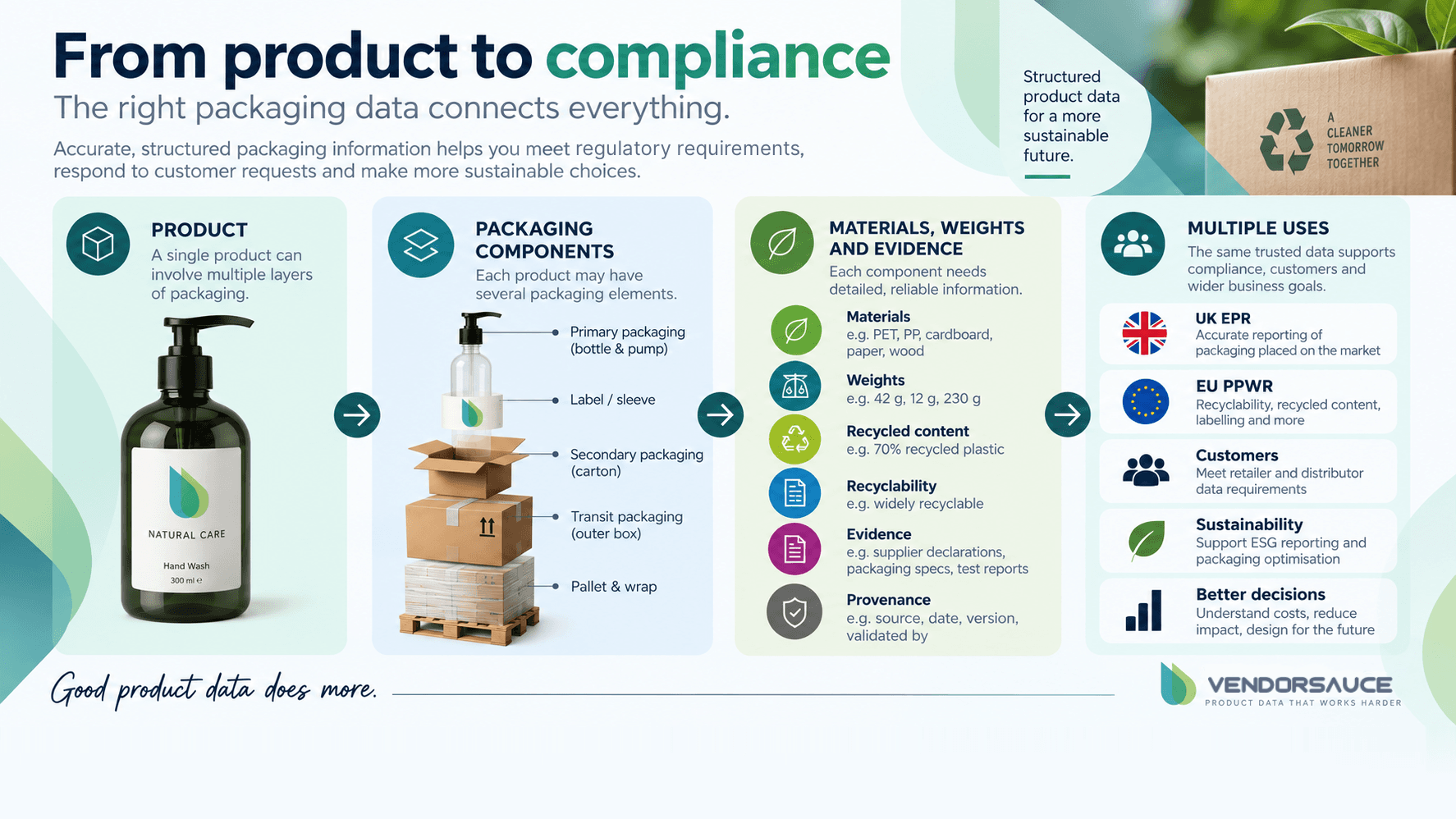
From the supplier and manufacturer perspective
Packaging has traditionally been treated as something that sits around the product rather than as part of the product data itself.
That distinction is becoming increasingly difficult to maintain.
In the UK, Extended Producer Responsibility for packaging (EPR) already requires affected businesses to collect and report detailed information about the packaging they place on the market. Large producers report every six months, and the next deadline is 1 October 2026, covering January to June 2026.
At the same time, the EU's Packaging and Packaging Waste Regulation (PPWR) began applying across the EU on 12 August 2026. It introduces progressively stronger requirements around recyclability, material composition, recycled content, packaging minimisation, labelling and reuse.
For manufacturers, suppliers, importers and distributors, that raises a very practical question.
Where does all the data needed to comply actually come from?
The reporting requirement is only the end of the process
It is easy to think of EPR as a reporting exercise. In reality, reporting is the last step in a much longer data collection process.
Under UK EPR, organisations that meet the relevant thresholds must report on the packaging they supply or import. The guidance requires packaging to be classified using defined activity, packaging type, class and material codes, and expects the data submitted to be "as accurate as reasonably possible".
To produce that reliably, a business may need to know:
- what packaging is associated with each product
- the individual packaging components
- the material each component is made from
- the weight of those materials
- whether the packaging is primary, secondary or transit
- who is responsible for that packaging within the supply chain
- where products and packaging are being supplied
- and increasingly, how recyclable the packaging actually is
Multiply that across hundreds, thousands or hundreds of thousands of SKUs and the challenge becomes obvious.
The problem is rarely creating the final CSV file. The problem is creating trustworthy data to put into it.
Packaging data is often scattered across the business
From the conversations we are having with manufacturers and suppliers, the underlying information often exists - just not in a form that is easy to use.
Some of it is held in ERP systems. Some is in packaging specifications. Some comes from packaging suppliers. Some is buried inside PDFs, technical documents or spreadsheets. Some sits with individual product managers.
And some has simply never been recorded, because nobody needed it at product level.
A single finished product might involve a plastic bag, a cardboard carton, a printed sleeve, a label, an insert, protective foam and transit packaging. Knowing that it comes in "a cardboard box" is no longer enough.
Businesses increasingly need structured information about each packaging component and the materials within it - and that information needs to stay linked to the correct product, variant and market.
PPWR pushes the requirement much further
The EU's PPWR makes the direction of travel particularly clear.
It replaces the old Packaging Directive with a single, directly applicable Regulation covering the whole packaging lifecycle, and it puts far more emphasis on how packaging is designed and what it is made from. Its requirements include progressively tighter rules on recyclability, minimum recycled content in plastic packaging, packaging minimisation, substances of concern, labelling and reuse.
All packaging placed on the EU market is to be recyclable by 2030, with detailed design-for-recycling criteria and recyclability performance grades being introduced as the regime develops. For plastic packaging, minimum recycled-content targets apply from 2030, varying by packaging type and rising again towards 2040.
So the question is moving beyond:
What does this product come in?
towards:
Exactly what is it made from, in what quantities, how recyclable is it, what recycled content does it contain - and can we demonstrate that?
Those are data-management questions as much as regulatory ones.
The packaging hierarchy matters
Another complication is that packaging does not map neatly onto a single SKU.
A product may have its own consumer packaging. Several of those may then go into an outer carton. Multiple cartons go onto a pallet, which is wrapped in film and secured with straps:
Product → Primary packaging → Inner pack → Outer carton → Pallet → Wrap and straps
Each level can have different materials, weights and responsibilities. Some packaging structures are shared by many products. Others vary by product size, pack quantity, supplier, production site or destination market.
Representing those relationships in a conventional flat product spreadsheet quickly becomes difficult. Keeping them accurate as products and packaging change is harder still.
And then there is evidence
It is becoming less and less sufficient simply to hold a value in a database. Businesses increasingly need to know where that value came from.
If a packaging record says a component weighs 42 grams and contains 70% recycled plastic:
- Who supplied that information?
- When was it supplied?
- Which packaging specification supports it?
- Does it apply to every product using that packaging?
- Has the packaging changed since the information was collected?
- Has anyone validated it?
Provenance is becoming important across product compliance generally, and packaging is no exception.
UK government guidance already sets out how to record a methodology explaining how your packaging data was gathered, sampled and checked. Only online marketplaces are currently required to submit one, but for everyone else it provides evidence of a clear process - and the regulators may use it as part of compliance audits.
Collect once, use many times
There is a danger that businesses approach every new regulation by creating another spreadsheet and another data-gathering exercise. That quickly becomes unsustainable.
Packaging data collected for EPR can support far more than a single regulatory submission. The same structured information may be needed for:
- UK EPR reporting
- recyclability assessments
- EU PPWR compliance
- packaging optimisation
- sustainability and ESG reporting
- retailer and distributor data requests
- supplier declarations
- packaging cost analysis
- customer-facing environmental information
The objective should not simply be to complete the next return. It should be to establish a reliable source of packaging information that can be reused whenever it is needed.
Packaging needs to become part of the product data model
This is where we believe the bigger change lies.
For many organisations, packaging data has historically sat outside the core product information model. That is unlikely to remain practical.
A modern product record increasingly needs to describe not only the commercial and technical characteristics of the item itself, but also the packaging associated with it - structured components, materials, weights, evidence and market-specific compliance information.
That does not mean every organisation needs to rebuild its systems. But it does mean packaging information needs somewhere structured to live.
It needs ownership. It needs validation. It needs versioning.
And increasingly, it needs to be exchanged with customers, regulators and other systems without somebody rebuilding it by hand every time.
Start with the data, not the return
If your organisation is finding EPR reporting difficult, the underlying problem may not be EPR itself. The reporting requirement may simply be exposing a product data problem that already existed - and the same will increasingly be true as PPWR requirements develop.
Rather than asking:
How do we fill in the packaging report?
a more useful question may be:
Do we have a reliable, structured and repeatable way of knowing exactly how every product we sell is packaged?
For many businesses, the answer today is still "not quite". With packaging regulation becoming more detailed rather than less, now is a good time to fix that.
VendorSauce provides a structured environment for collecting, validating, enriching and distributing product information - and packaging information can form part of that record, whether it is collected from internal teams and suppliers, imported from existing systems, or extracted from the specifications and documents you already hold. The aim is reusable, governed product and packaging data that supports regulatory reporting, customer requirements and future obligations, rather than another isolated spreadsheet exercise. If packaging data collection is becoming a challenge, we'd be happy to show you how a more structured approach could work.
This article provides a general overview of product data considerations associated with packaging regulation and is not legal or regulatory advice.
Sources